A family history, Hilversum 1922 to California 1995
A life across oceans.
Before he was Bert, he was Gisbertus Wilhelmus Paap. A Dutch seaman whose life crossed oceans, a world at war, and the long passage to a new home.
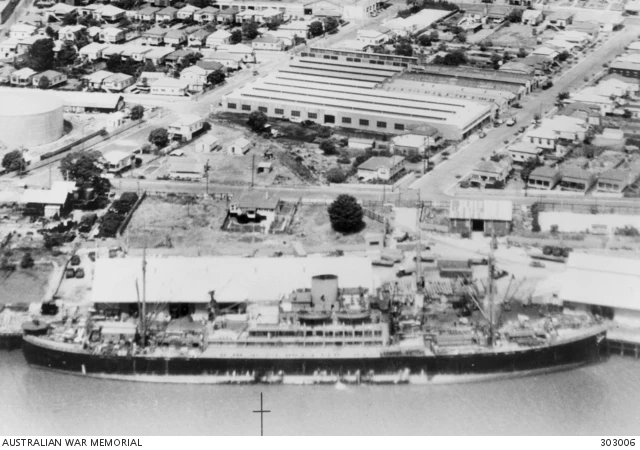
Australian War Memorial 303006 ↗
IThe voyages
The world, one port at a time.
The Dutch personnel card records Bert’s service aboard Bloemfontein from April 1941. Public archive records trace the ships, wartime passages and later New York arrival.
25 dated entries follow his years at sea and the beginning of his American life.
Voyage chart Recorded ports
PACIFIC OCEAN
Connections between recorded ports. The route at sea is unknown.
Dated ledger
Browse all 25 entriesBrowse the full log to search by name, date, port or ship.
The full dated log 25 entries · search or filter the record
↳A world at war
War reached
the crossing.
News from Pearl Harbor. Two close calls aboard Weltevreden. The records connect his working life to a much larger war.
News across the Pacific.
Bloemfontein had left Honolulu eight days earlier. The convoy was at sea when Pearl Harbor was attacked.
Watch the Pearl Harbor sequence ↗Two close calls.
Torpedo wakes behind the convoy. Bombs between the transports. Weltevreden survived both attacks during Bert’s recorded service.
Watch the close calls ↗Read the close-call reports2 and 7 September 1943 · what the records say
WELTEVREDEN · SEPTEMBER 1943
Two close calls during his service.
Bert’s recorded engagement ran from 28 July to 16 October 1943. American operational reports place Weltevreden in both of these attacks.
02 SEPTEMBER
Compare the ACORN Eleven report ↗
Torpedo wakes behind the convoy.
Bound for Guadalcanal, the formation made an emergency turn after torpedo wakes were seen astern. The commander’s report estimated two torpedoes passed 50–500 yards behind the formation. ACORN Eleven’s account instead records a torpedo about 100 yards astern of Weltevreden and Sea Bass, at a slightly different time.
No ship was reported hit. The submarine was not identified.
Read the original torpedo-attack report ↗Compare the ACORN Eleven report ↗
07 SEPTEMBER
Bombs between the transports.
After leaving Guadalcanal, Weltevreden sailed with Alhena and the escorts Fanning and Cony. A Japanese twin-engined bomber dropped three bombs between the transports, reported about 300 yards off Alhena’s port beam. No damage was reported.
Alhena fired after the bombs fell. The report criticised the escorts’ radar tracking and failure to take offensive action.
Read the original air-attack report ↗The personal connection The attacks overlap Bert’s employment. The surviving reports do not name him, identify his station, or record his own account.
Jagersfontein: a former ship lostThe sinking, rescue and original Navy photographs
26 JUNE 1942 · EAST OF BERMUDA
The sister ship
that did not return.
Jagersfontein was bound from Galveston to Liverpool when U-107 torpedoed her. The neutral Swiss ship St. Cergue rescued the survivors the next day; some later transferred to USS Bernadou.
The U.S. Navy’s photographic collection preserves the sinking. These are images of a former ship, not an event Bert is known to have witnessed.
Bert’s record Jagersfontein in 1940. Bloemfontein at the time of the sinking.
Explore the Navy’s sinking photographs ↗Sloterdijk before BertSeabrook’s earlier wartime account
An earlier wartime chapter.
William C. Seabrook’s In the War at Sea describes Sloterdijk evading two submarine torpedoes off Tjilatjap on 1 March 1942 and evacuating 330 Dutch naval personnel to Australia. His account also describes a German air attack on a Glasgow–Palermo convoy in early November 1943.
Bert’s documented time aboard came later: 14–26 December 1944. Seabrook’s chapter supplies the ship’s earlier history, with no itinerary or attack account for Bert’s service periods.
Read Seabrook’s Sloterdyk chapter · pp. 43–45 ↗IIThe ship
A closer look at Bloemfontein.
Built in Amsterdam in 1934, Bloemfontein carried passengers and cargo before wartime service. Explore the ship and the details of her 1942 armament.
Open the original plansBoats, upper works and the shape of the decks
FROM THE DRAWING ROOM · 1933–34
Reading the original plans.
Boat dimensions, deck curves and the shape of the upper works bring the ship into sharper focus.
THE ORIGINAL DRAWINGS
Open the plans in the museum collection.
Three builder’s drawings for Bloemfontein and her sister ship Jagersfontein, held by Het Scheepvaartmuseum, Amsterdam. Maker: Nederlandsche Scheepsbouw Maatschappij (NSM).
Lines plan
Lijnentekening
Hull profile, waterlines and transverse sections.
- Catalogue
- B.0226(02)
- Date
- 1934
General arrangement
Algemeen plan, dekplan
Deck layouts, the bridge, funnel and boats.
- Catalogue
- S.5444(143.02)
- Date
- 1934
Sheer and camber
Zeeg- en dekrondteplan
The longitudinal sweep and transverse rise of the decks.
- Catalogue
- S.5444(143A.11)
- Date
- 1934 catalogue; tracing 15 Sep 1933
Additional plan reference: Maritiem Museum Rotterdam, TS7267-137a and TS7267-137b. These general-arrangement sheets informed the model’s proportions and deck details.
The links open the original archival records. The illustrations below are newly drawn explanatory studies, not reproductions of those plans. The builder’s drawings describe the civilian design; the dated wartime equipment list supplies a separate layer.
AS-BUILT ARRANGEMENT
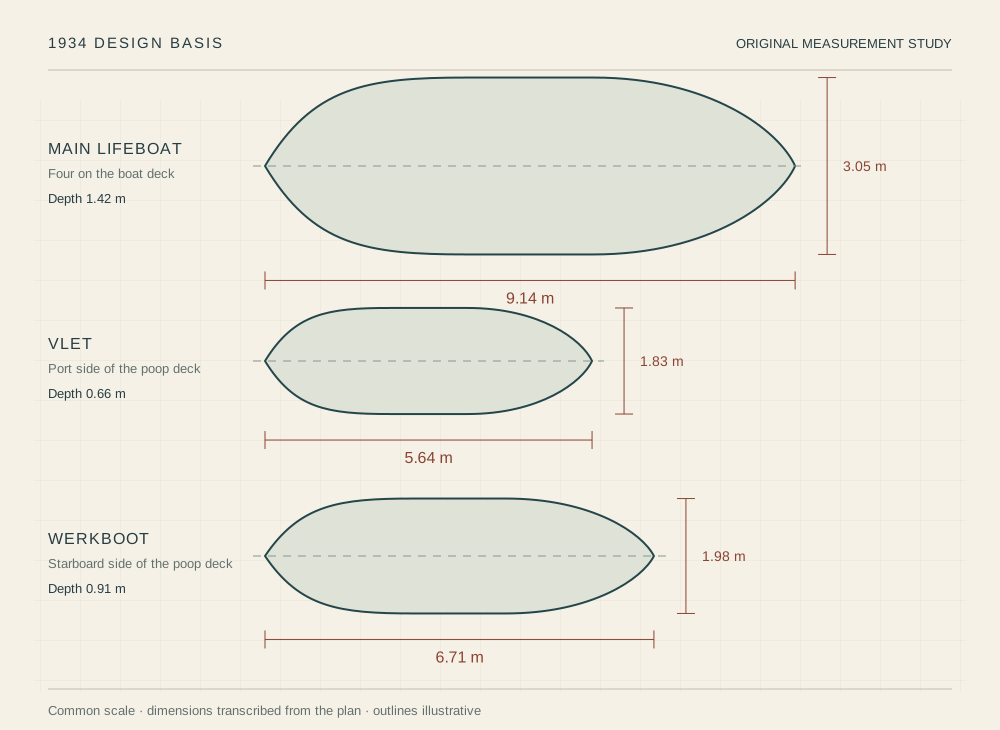
Four lifeboats. Two smaller boats.
The boat-deck drawing labels each main lifeboat 9.14 × 3.05 × 1.42 metres. The two smaller boats aft are unequal: a port-side vlet and a longer starboard workboat.
- Main lifeboat
- 9.14 × 3.05 × 1.42 m
- Vlet
- 5.64 × 1.83 × 0.66 m
- Workboat
- 6.71 × 1.98 × 0.91 m
Length × breadth × depth. This is the civilian design; the two stern boats’ wartime retention is unconfirmed.
View the original deck-plan record ↗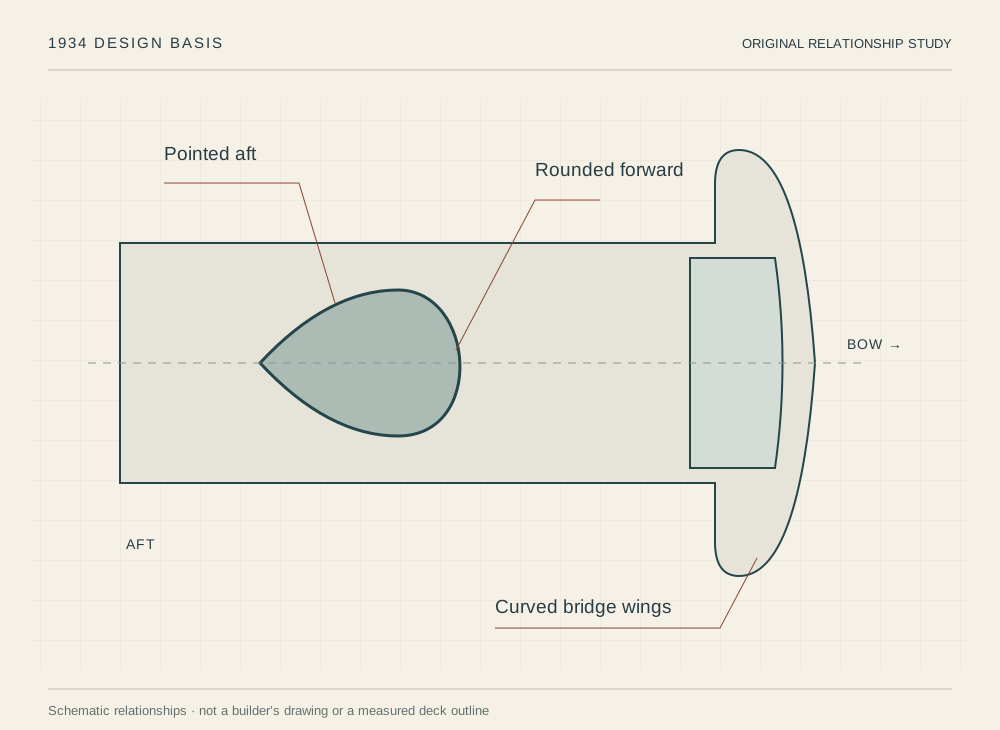
BRIDGE-DECK PLAN
A shape photographs can hide.
Seen from above, the funnel has a rounded forward face and a pointed after end. The bridge spreads beyond the wheelhouse into broad, curved wings.
These relationships distinguish Bloemfontein’s upper works from a generic passenger ship. The plan supplies the footprint; elevations and photographs guide the height.
The sketch isolates those relationships. It does not reproduce the builder’s drawing or establish a precise wartime outline.
View the original upper-deck record ↗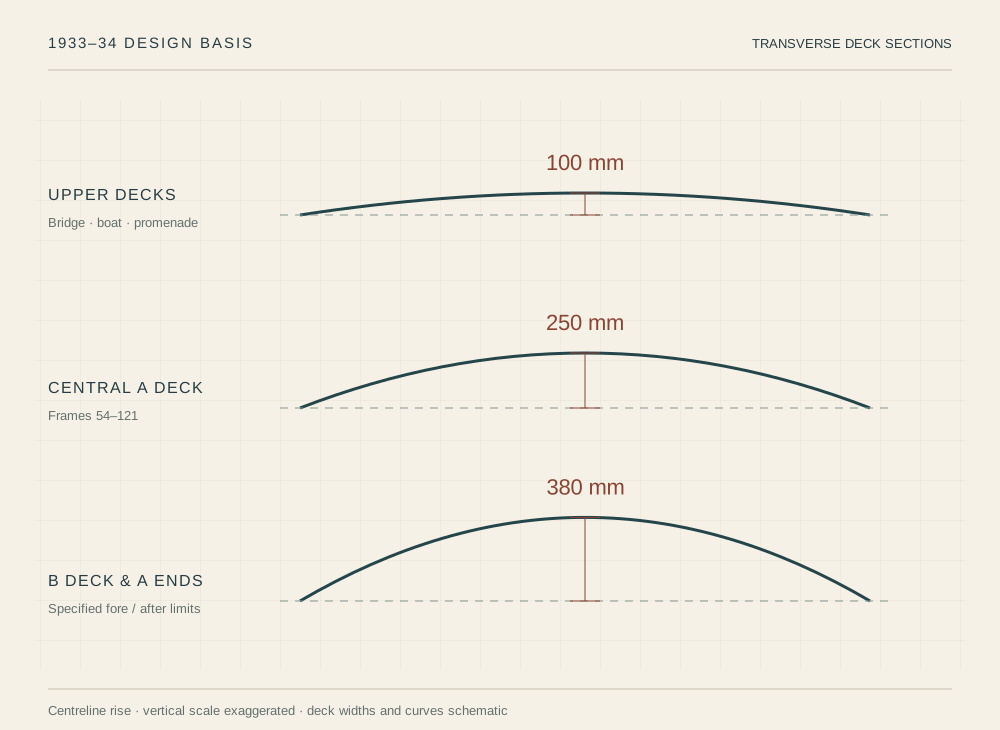
DECK-CAMBER DRAWING
A subtle rise underfoot.
The decks are not flat across the ship. They rise gently toward the centre, with different values assigned to different decks and frame ranges.
- Bridge, boat & promenade
- 100 mm
- A deck, frames 54–121
- 250 mm
- B deck & specified A-deck ends
- 380 mm
The tracing is dated 15 September 1933 and catalogued under 1934. Each value belongs to its marked deck region.
View the original camber record ↗How the plans changed the model
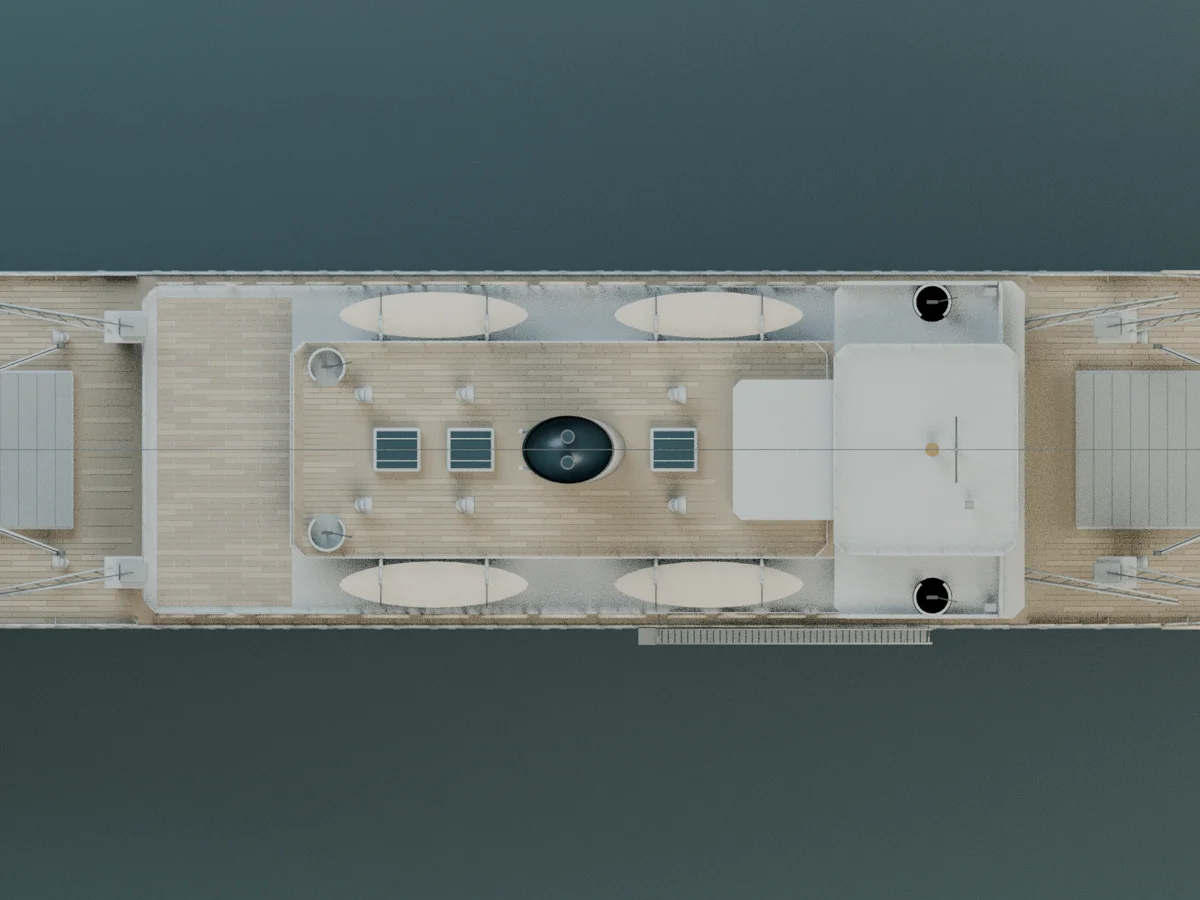
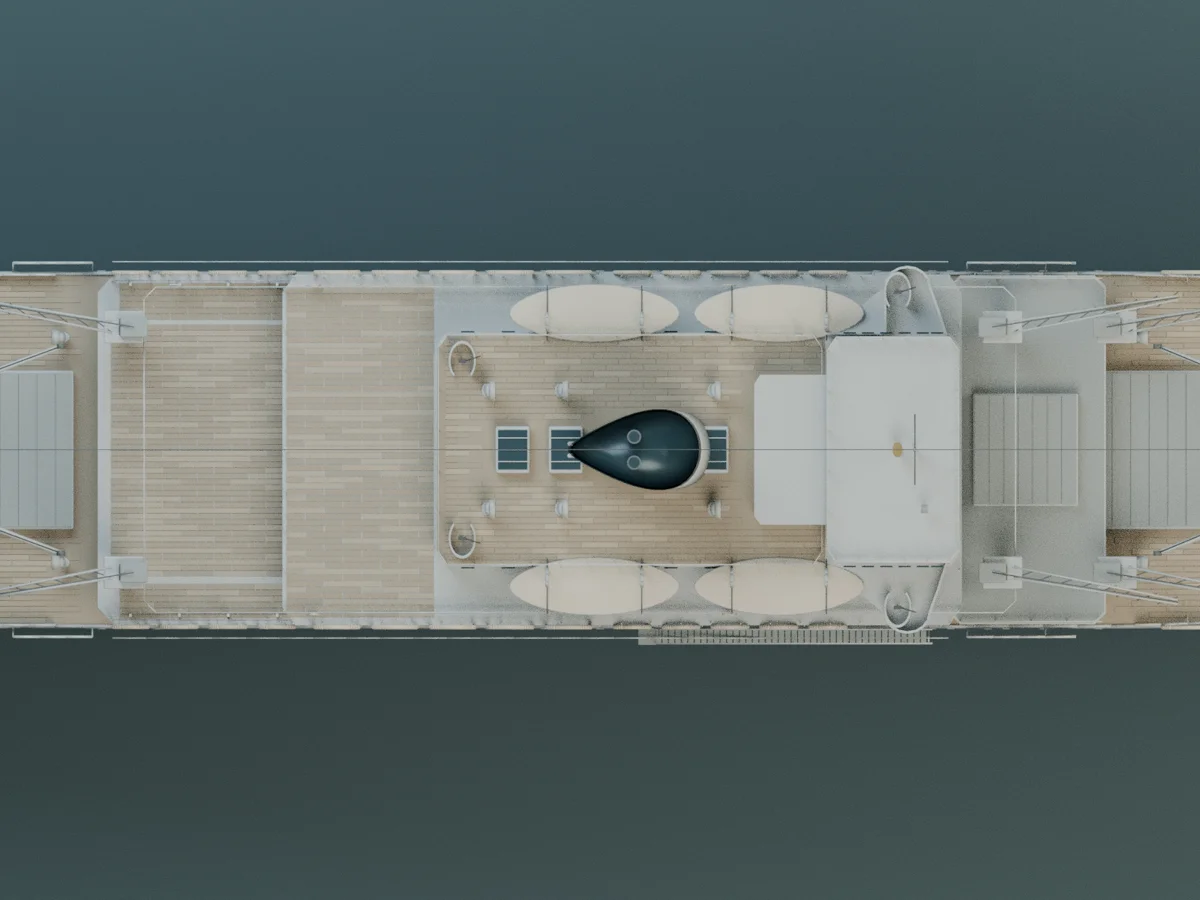
Printed boat dimensions replace the earlier proportions. The stepped deck lengths and funnel footprint follow measurements from the drawing, with roughly half a metre of uncertainty. Both views use the same camera and lighting.
IIIThe cargo
A fighter, carried as cargo.
Bloemfontein carried eighteen P-40 fighters in the Pensacola convoy. They crossed the Pacific in crates.
CURTISS P-40ETHE CARGO · DECEMBER 1941
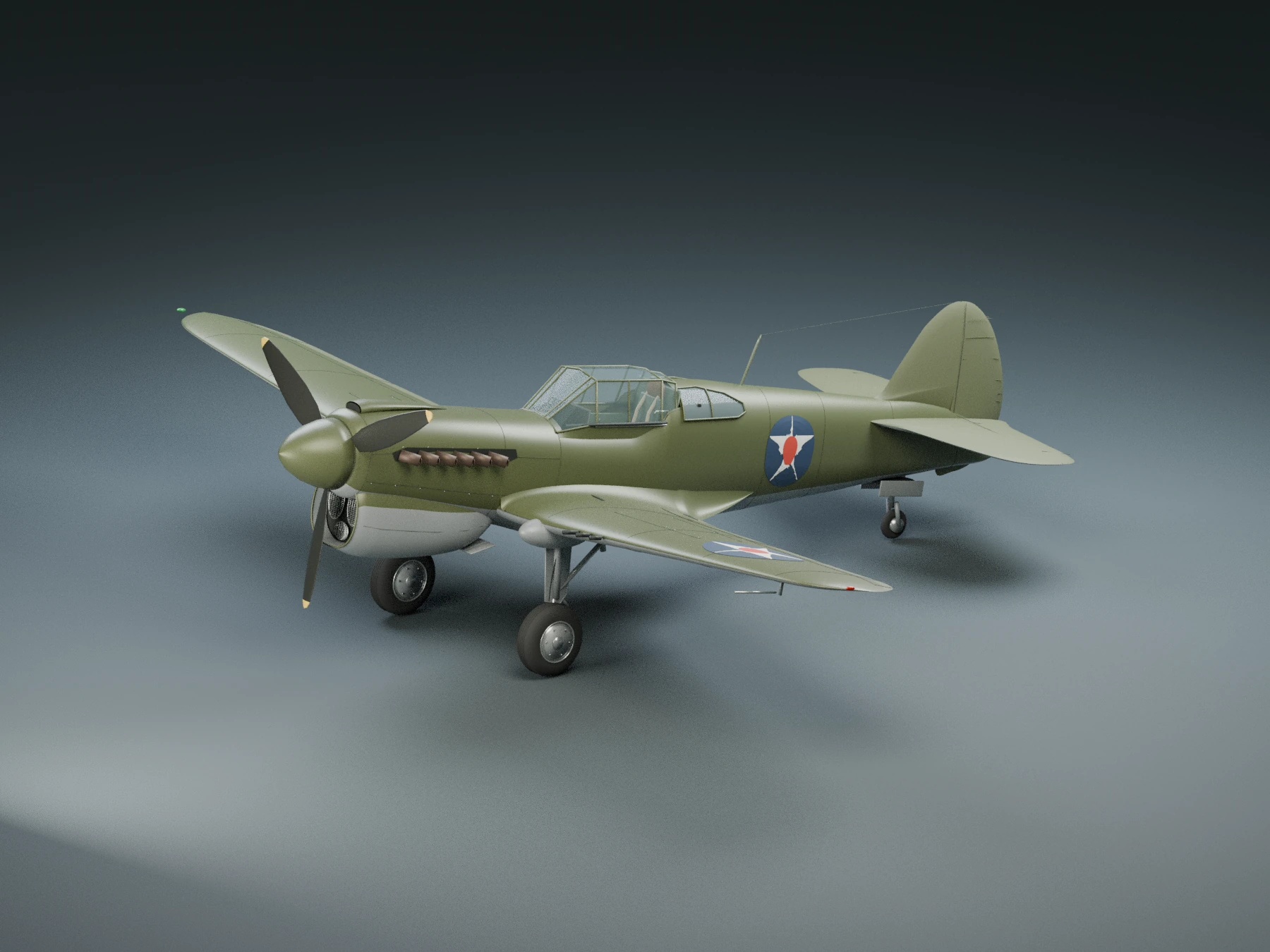
The interactive study loads as you approach.
Plate 5. Curtiss P-40E. Drag to turn, or use the views below.
Drag to turn · Pinch to zoom · Arrow keys to orbit · + / − to zoom · Home to reset
Eighteen fighters, one ship
18 P-40s · transported crated
Explore the cargo studyReference drawings, sources and what remains unknown
DECEMBER 1941
Crated for the crossing.
The U.S. Army’s official history identifies 18 P-40s aboard Bloemfontein; the Northern Territory archive describes them as crated. Army history ↗ · Archive description ↗
The individual aircraft are not identified in the records.
About the aircraft study
Why a P-40E?
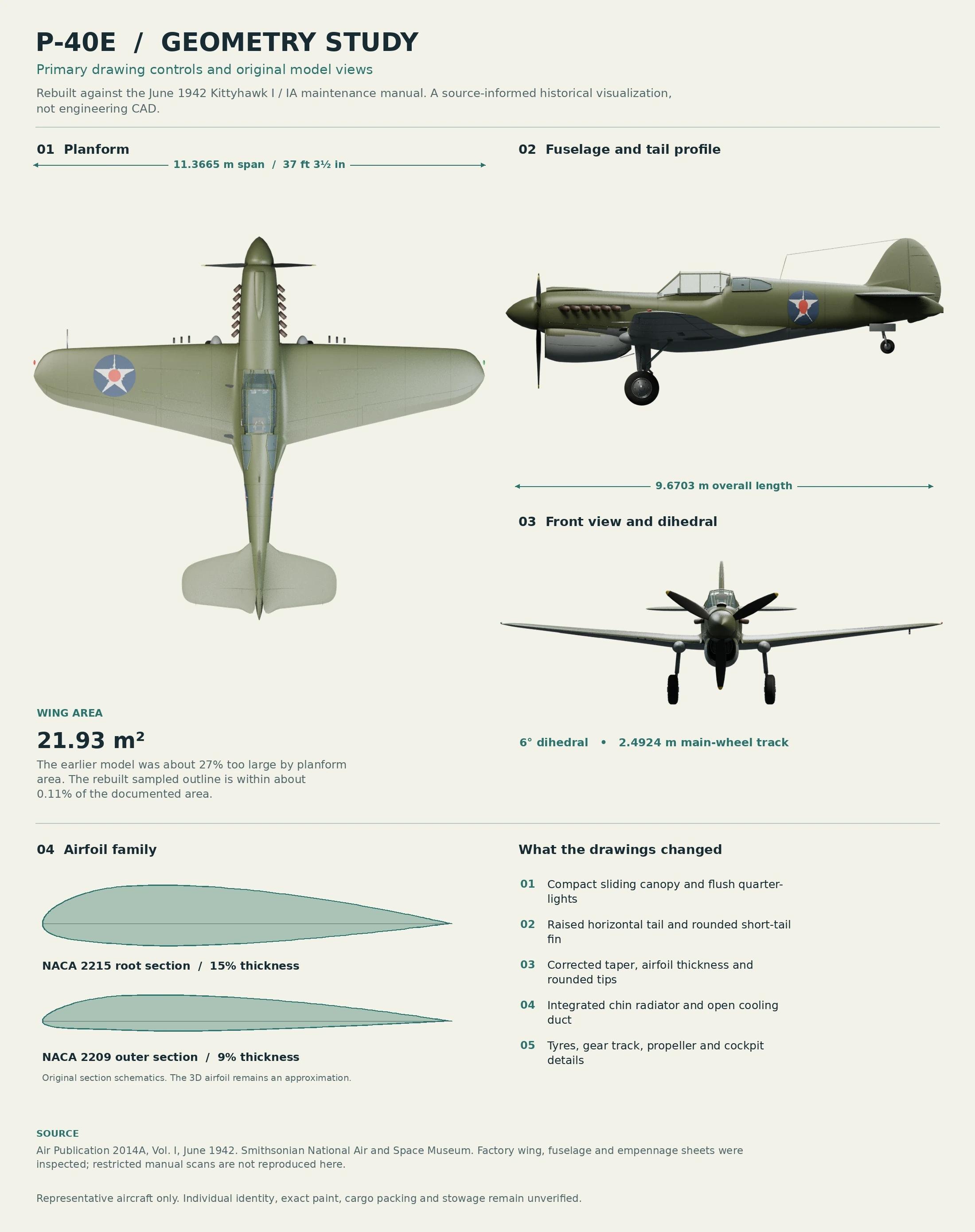
ADF Serials’ specialist history identifies the convoy’s fighters as P-40Es. Its allocation of aircraft between ships differs from the official Army account, so it is used here only to inform the representative variant. The revised geometry uses the June 1942 Kittyhawk I/IA manual preserved by the Smithsonian; museum photographs provide additional form checks.
What the original drawings changed
The revised wing matches the manual’s 236 sq ft area and 37 ft 3½ in span, about 21.93 m² and 11.37 m. Its taper, dihedral and thickness were corrected along with the Allison cowling, shorter canopy, tail, radiator opening and undercarriage. The earlier model’s wing area was about 27% too large.
Factory wing, fuselage and empennage sheets guide the form; the cockpit and fine surface details remain a visual interpretation. This is not manufacturing CAD or an identified convoy airframe.
↳Service register
Eight ships. Eight stories.
His service, and what came after. Open a name for dates, records and the ship’s fate.
011950
Nijkerk
Sold for demolition
Completed in 1919 after a 1915 launch. Sold to Frank Rijsdijk at Hendrik-Ido-Ambacht in February 1950.
MARHISdata · ship register ↗021953
Klipfontein
Lost in peacetime
Sank off Mozambique on 8 January after striking a submerged obstruction. All 234 passengers and crew were rescued by Bloemfontein Castle, a different ship from Bert’s Bloemfontein. The obstruction remains disputed.
Simon’s Town Historical Society · pp. 131–132 ↗031942
Jagersfontein
Sunk by U-107
Torpedoed east of Bermuda on 26 June. Everyone aboard survived. Bert’s Jagersfontein record belongs to 1940; his personnel card places him aboard Bloemfontein when she was lost.
uboat.net · loss and rescue record ↗041959
Bloemfontein
Broken up in Hong Kong
Survived the war and returned to civilian service. Her long career ended at the breakers in Hong Kong in 1959.
L. M. Potgieter · ship history, pp. 12–13 ↗051963
Weltevreden
Survived the attacks
The ship survived her September 1943 close calls and the rest of the war. She was scrapped in 1963.
U.S. Naval History and Heritage Command ↗061958
Boschfontein
Fire, then the breakers
Renamed Boschkerk in 1956. A severe fire at Rotterdam on 19 October 1958 was followed by sale for demolition that December and arrival at Hamburg on 26 December.
MARHISdata · ship register ↗071962
Tjisadane
Broken up in Japan
Sold for demolition to Nomura Trading. Arrived at Kure on 14 May 1962 and was handed over on 22 May.
MARHISdata · ship register ↗081966
Sloterdijk
Broken up in Spain
The final ship in Bert’s surviving service record outlasted the war by two decades. Sold for scrap on 3 March 1966; arrived at Bilbao on 30 March.
MARHISdata · ship register ↗Service dates come from Bert’s personnel record. Ship histories distinguish events during his service from those before or after it.
IVThe evidence
His name.
In their handwriting.
Crew lists, a personnel card, a captain’s letter. Read the documents behind the story.
Three starting points in the original record.
A captain remembers PapeeteThe original Dutch letter and English reading
FROM THE CAPTAIN’S ACCOUNT
“Papeete is
a safe harbor.”
Captain Corten remembered the narrow reef entrance, a two-ship pier, and the wait for copra from neighboring islands.
Captain Corten, replying to a 1951 inquiry.The source register Search the references behind the research
VAfter the war
Another shore.
A life still coming into view.
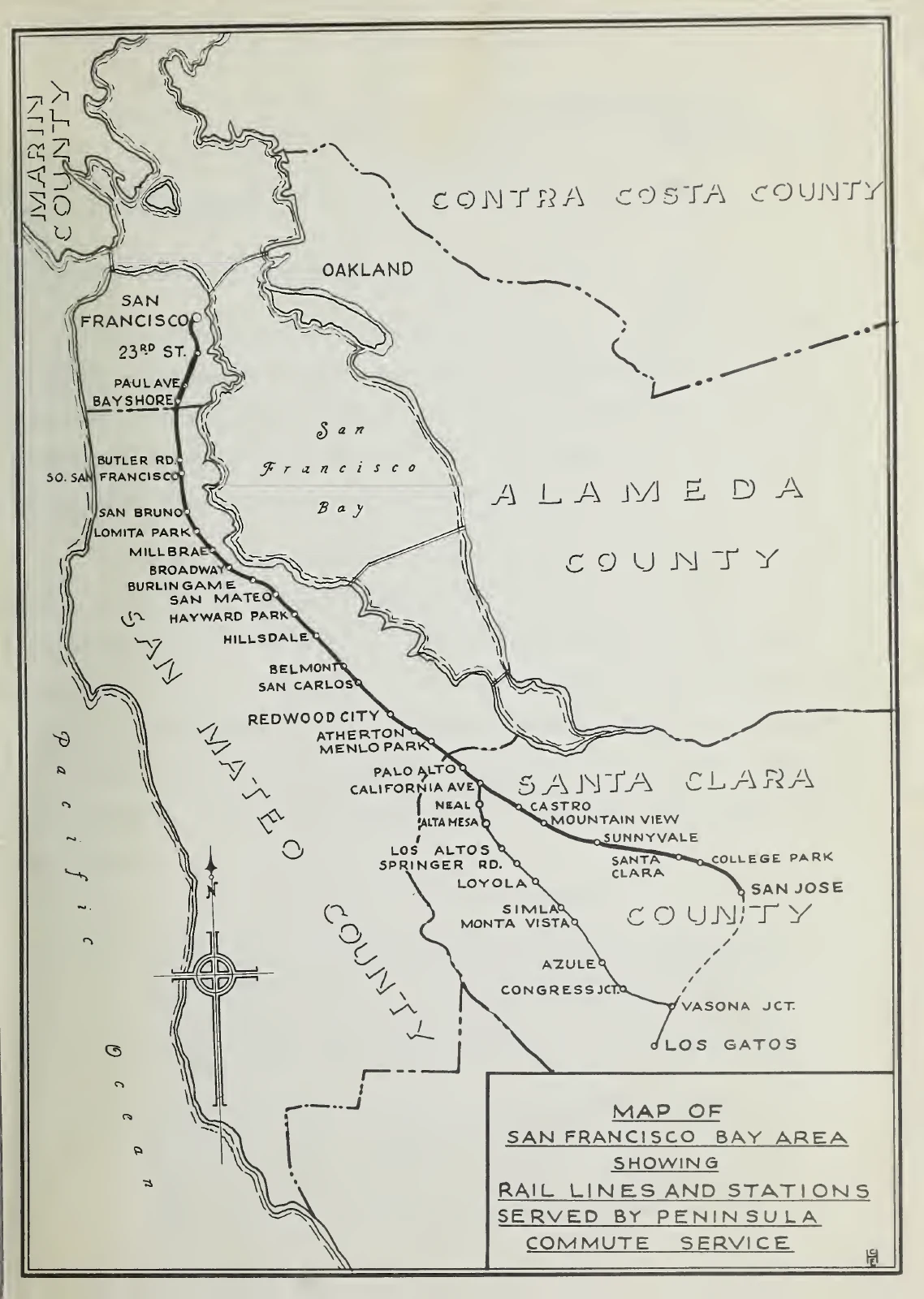
California Public Utilities Commission · original network map ↗
Regional context, not a map of Bert’s movements.
Proprietor. Trucking.
In the 1950 Santa Clara County census, Gysbertus W. Paap is 28 and running a trucking business. He had worked seventy-two hours the previous week.
Census · ED 43-179, sheet 91 ↗Work, family and a community
His 1995 obituary remembers a Shippers Express truck driver, Teamsters member, Little League coach and Cub Scout leader.
Register-Pajaronian · 22 April 1995 ↗A note on wartime service
The obituary’s reference to U.S. Navy service has not been confirmed. Contemporary records place Bert in the Dutch merchant service.
AFTER THE WAR
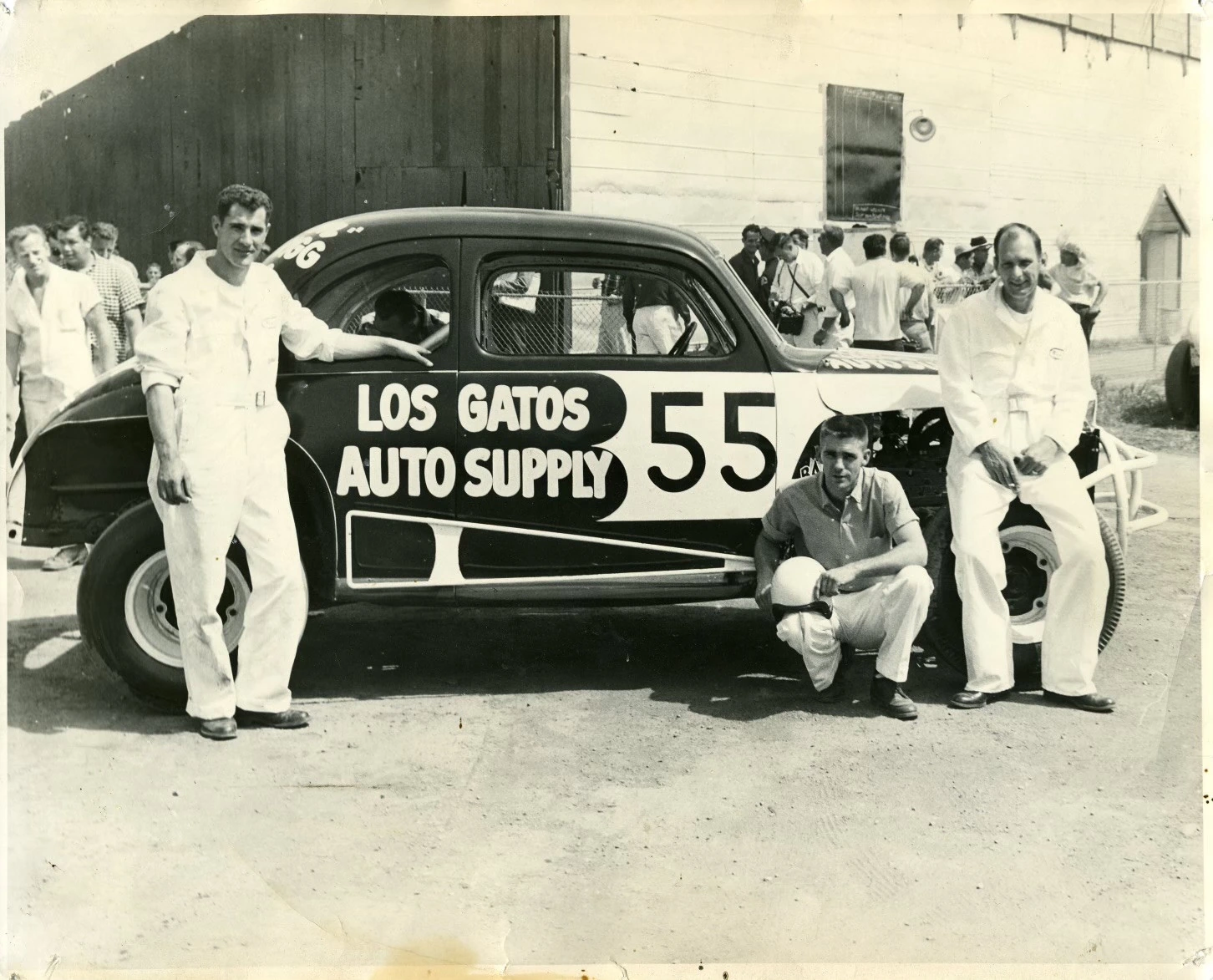
Beside car No. 55.
Arend and Bert beside a hardtop racer, with Los Gatos Auto Supply painted on the door.
Play the photo tour 52 seconds · Nine details in one photograph
Read the racing researchCar No. 55, Arend and Los Gatos Auto Supply
CAR NO. 55
A family photograph.
The number 55 is clear on the door. Who drove or owned the car is still to be found.
THE RACING RECORD
Arend at the speedway.
Legends of San Jose Speedway names Arend Paap in its photo gallery and 1960–62 results. No entry yet connects him or Bert to this car.
Arend caption · Speedway photo gallery ↗Speedway driver index ↗THE NAME ON THE CAR
Los Gatos Auto Supply.
A 1952 supplier list puts the business at 122 North Santa Cruz Avenue. A later FTC record names H. C. Jepson as its proprietor.
1952 supplier list · PDF page 8 ↗FTC business identification · printed page 1558 ↗MEANWHILE, IN THE NETHERLANDS
A family divided by war.
His brother Jacob, known as Jaap, joined the Dutch resistance. Remembrance records place his death near Rheinsberg on 23 April 1945.
Dutch War Graves Foundation ↗Sachsenhausen Memorial · source-qualified remembrance register ↗About this record
The Sachsenhausen Memorial bases its entry on secondary remembrance sources. The original missing-person case is still to be consulted.
STILL TO FIND
The unfinished pages.
01The details of his postwar arrival and settlement.
02The missing ports between the surviving records.
03More of his work, family life and years in California.